
In the Mauritius property market, investment discussions often gravitate quickly and compulsively toward price. How much does it cost? Is it good value compared to comparable assets? Can it be acquired more cheaply? These are legitimate analytical questions, and price discipline, the refusal to overpay relative to fundamental value, is genuinely important in every real estate investment framework. But focusing on acquisition price at the expense of a rigorous assessment of asset quality is one of the most consistent and most consequential mistakes that property investors in Mauritius make, particularly those who are relatively new to the market and who have not yet observed the full-cycle performance of assets across the quality spectrum.
The Apavou Group’s approach to asset selection in Mauritius, shaped across more than four decades of development and investment activity by founder Armand Apavou, is grounded in a clear and tested conviction that asset quality is the primary determinant of long-term investment performance. Projects like Plaisance Mall, Terre d’Été, and The Cube reflect this conviction in their design, their construction specification, their location selection, and their ongoing management, all developed or acquired with an explicit commitment to quality standards that would sustain and grow value across multiple market cycles, not just optimise the acquisition price metric at the moment of commitment.
Defining asset quality in the mauritius context
Asset quality in the Mauritius real estate market has several distinct and interconnected dimensions, each of which contributes independently to the long-term investment performance of the asset. Location quality, the physical, economic, and social characteristics of where the asset is situated, is the most fundamental dimension, and the one with the most enduring and compounding influence on long-term value performance. In the Mauritius context, location quality means different things in different asset segments: for premium residential development, it means proximity to quality coastline, natural beauty, established resort amenity, and the infrastructure that international buyers require and value; for commercial development, it means accessibility, infrastructure quality, the density of economic activity and business concentration in the surrounding area, and connectivity to the key business and transport hubs of the island.
Construction quality, the specification of structural materials, the engineering standards applied to the building, the quality of mechanical and electrical systems, and the durability of interior and exterior finishes, is the second critical dimension of asset quality in Mauritius. In the demanding tropical climate of the island, where intense solar radiation, high humidity, potential for cyclonic conditions, and the corrosive effects of marine air in coastal locations create particularly challenging conditions for building fabric, construction quality has a direct and measurable bearing on the long-term maintenance cost of the asset, on its ability to maintain its physical and aesthetic integrity over decades of use, and on its ability to sustain the quality positioning that supports rental income and capital value.
How quality manifests differently across mauritius asset classes
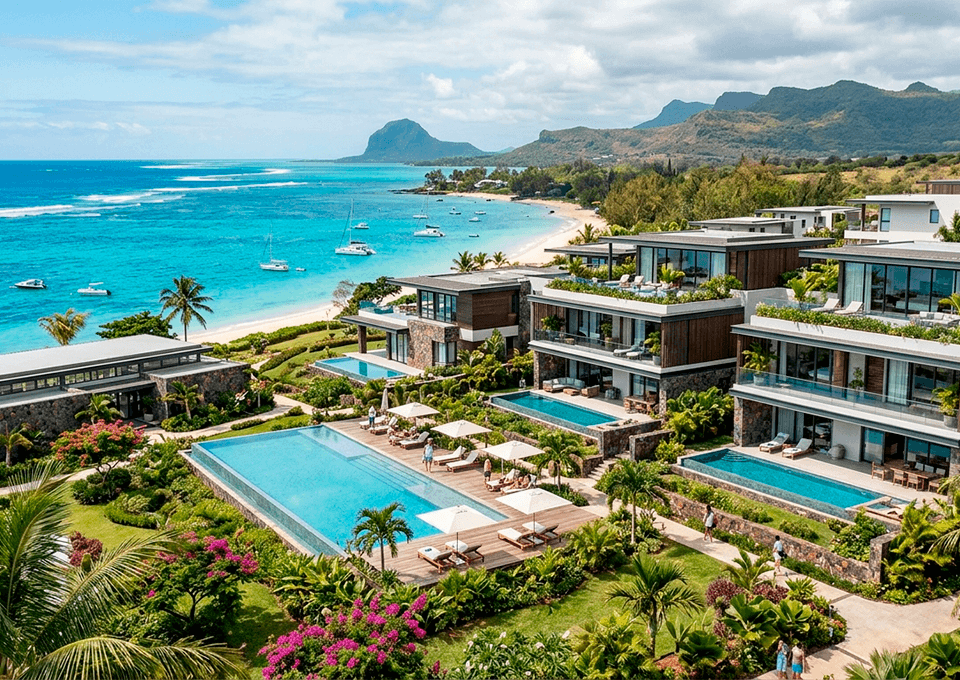
In the premium residential segment, represented by developments like Terre d’Été in the Apavou portfolio, quality manifests in the fineness of the construction specification, the thoughtfulness of the spatial design in relation to the tropical living experience, the quality of communal amenities and landscaping, and the attention to the details that high-net-worth international buyers notice and value. In this segment, quality is visible and immediately experienced, buyers can distinguish genuine quality from superficial finish, and the market premium for authentic quality in a Mauritius residential context is significant and durable.
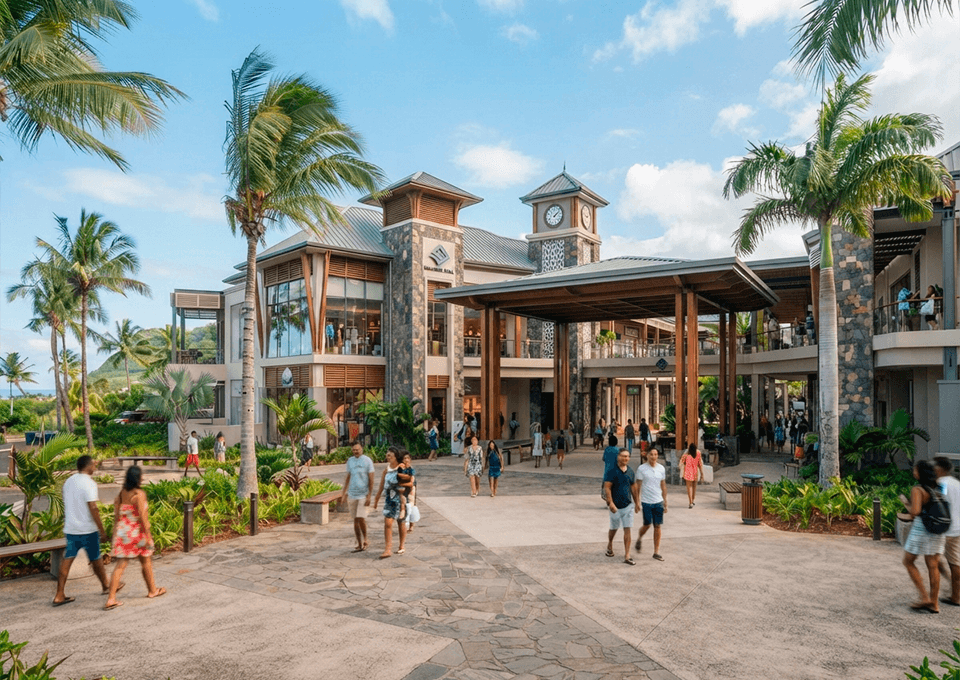
In the commercial segment, represented by assets like Plaisance Mall and The Cube in the Apavou portfolio, quality manifests differently but equally importantly. It is visible in the structural adequacy of the building for its intended uses, in the quality and reliability of the building services that commercial tenants require, in the flexibility of the floor plates for different tenant configurations, and in the maintenance standards applied to common areas and building fabric. Quality commercial tenants, whose financial strength and lease terms provide the income security that justifies the investment, will not commit to below-quality commercial space on a long-term basis, and the market premium for quality in the Mauritius commercial segment is equally real.
The long-term evidence for quality premium in Mauritius
The most compelling evidence for the quality-over-price investment principle in Mauritius comes from observing how assets across the quality spectrum have performed through the market’s significant cyclical events. During the global financial crisis of 2008-2009, during the various tourism disruptions of subsequent years, and most dramatically during the severe economic shock of the Covid-19 pandemic, the performance differential between genuinely quality assets and secondary-quality assets in Mauritius was substantially larger than the price differential between them at acquisition. Premium-quality assets in superior locations held their value more effectively, maintained higher occupancy rates through difficult periods, and recovered more quickly and more completely in subsequent market recoveries. Secondary assets, cheaper to acquire but of inferior quality and location, experienced deeper value corrections and slower, more expensive recoveries. The initial price saving at acquisition was comprehensively outweighed by the performance differential over time.
The acquisition price trap and how to avoid it
The acquisition price trap in Mauritius real estate occurs when an investor prioritises achieving a lower purchase price over ensuring adequate asset quality, and rationalises this prioritisation through various forms of analytical optimism that underestimate the long-term cost of quality compromise. The trap manifests in several recognisable forms. The investor acquires a property that appears cheap relative to market comparables without adequately investigating why it is cheap, typically because the market is pricing in a quality differential that the investor has not fully understood or accepted. The investor selects a lower-quality asset over a higher-quality alternative to remain within a capital budget constraint, without adequately considering the long-term performance implications of the quality difference. Or the investor focuses excessively on the initial gross yield, which may be higher for the cheaper asset in the short run, without adequately modelling the total return over the full intended holding period.
Each of these manifestations of the acquisition price trap ultimately produces the same outcome over time: an investment that appeared more attractive on an initial price basis than the quality alternative, but that delivers inferior total returns across the holding period. The apparent initial saving is eventually, and generally more than fully, offset by lower net income from higher vacancy and maintenance costs, by a weaker capital value trajectory relative to the quality alternative, and by the higher transaction costs of managing an asset that requires more frequent operational intervention.
When paying more for quality is definitively the right decision
The argument that quality matters more than price is not a claim that price is irrelevant or that any price premium for quality is automatically justified. It is a claim that the appropriate investment comparison is not between two assets priced differently in absolute terms, but between two assets priced differently relative to the quality, durability, and income-generating capacity that each will deliver across a realistic long holding period. When a demonstrable quality differential justifies a price premium, and when that premium is within the range that the quality differential can be reasonably expected to support through the investment’s projected performance, paying the premium is the analytically disciplined and rationally correct decision.
The Apavou Group has consistently demonstrated this discipline across its Mauritius investment and development decisions over four decades. The group has been willing to pay appropriately for quality land in strategic locations, to invest in quality design and construction specification, and to maintain quality standards in asset management, without compromising on these elements to achieve a lower acquisition or development cost, because the long-term performance track record of quality assets across multiple Mauritius market cycles consistently demonstrates that this quality investment is justified by the superior returns it generates.
Evaluating quality before committing capital in Mauritius
For investors seeking to apply the quality-first framework in the Mauritius market, the practical challenge is how to evaluate asset quality comprehensively and objectively before committing capital. For existing completed assets, this means commissioning an independent technical survey from a qualified building surveyor with specific experience in the Mauritius construction environment, someone who can assess structural condition, building services quality, maintenance history and requirements, and the specific tropical climate performance of the building fabric. It also means evaluating the documented income track record of the asset and the financial quality of the tenant or occupier base, not just the headline rental yield figure.
For development projects, where the quality of the completed asset must be assessed from designs, specifications, and the developer’s track record rather than from a completed building, the quality evaluation is more demanding and requires deeper analytical engagement. Reviewing design drawings and structural specifications, assessing the quality and completeness of the mechanical and electrical services design, and most importantly evaluating the track record and financial capacity of the developer to deliver to the specified standards are all critical components of quality assessment for off-plan property acquisitions in Mauritius. For projects developed by established groups like the Apavou Group, whose completed portfolio at Plaisance Mall, Terre d’Été, and The Cube provides direct and verifiable evidence of delivery quality, this quality assessment is substantially more confident than for newer or less well-documented developers.
Quality is the most reliable form of value in Mauritius
In the Mauritius real estate market, asset quality is the most reliable and most durable form of investment value available at any scale of capital deployment. Quality assets in quality locations, maintained to high standards and managed with genuine professional discipline, consistently create and preserve value over time in ways that cheaper, lower-quality alternatives simply cannot replicate across full market cycles. The investors who understand this principle, and who apply the discipline to invest in quality even when cheaper alternatives are immediately available, consistently build Mauritius portfolios that outperform across the long time horizons that real estate investment requires. For Apavou Properties, this quality-first philosophy is not a marketing statement. It is the analytical foundation and operational principle on which every investment decision in the Mauritius market has been made across four decades of continuous activity.
 Previous Post
 Next Post
 123 456 7890
  help@sitename.com
 44 Broklyn Street, USA